Moss, debris and why caps fail early here
Moss and needle litter load a Pacific Northwest chimney crown and cap in a way drier climates never see. Here is why, and what actually slows it down.
Published
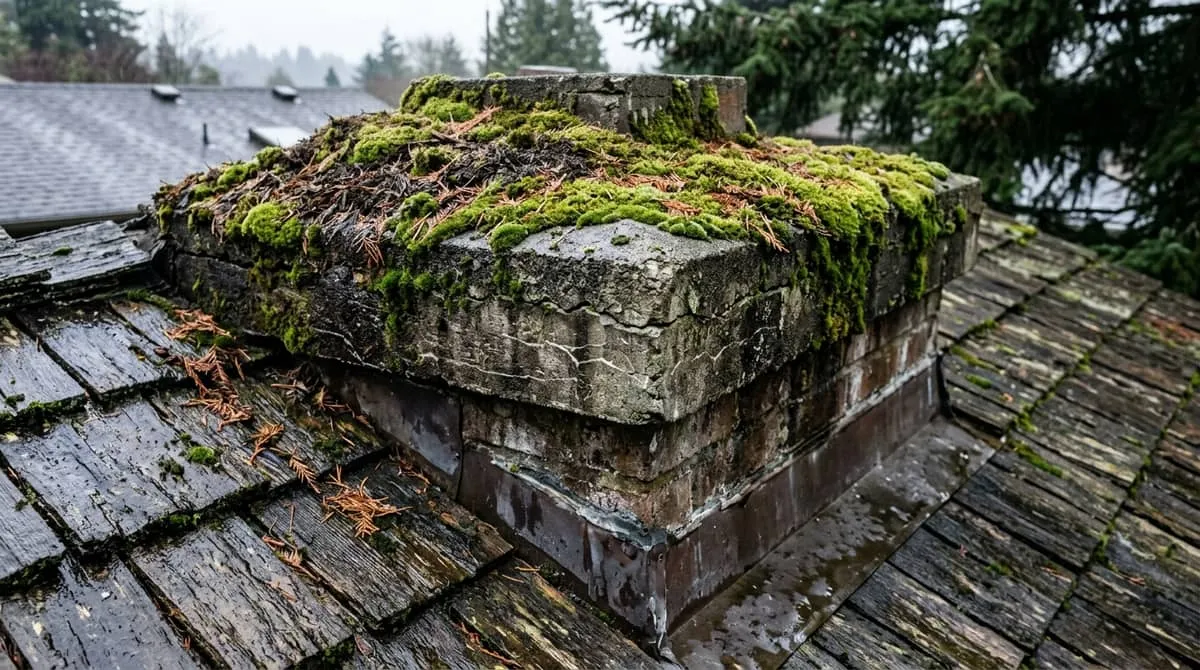
A chimney cap in Seattle or King County works under a load most of the country never deals with: near-constant shade, moisture and needle litter from evergreen canopy. Here is why that shortens a cap’s working life, and what actually helps.
A chimney cap manufactured to the same specification performs differently depending on where it is installed. A cap on a chimney in a dry, sun-exposed climate spends most of the year bone dry between rain events. The same cap installed under Pacific Northwest tree cover spends most of the year damp, shaded, and steadily accumulating organic debris that a drier climate’s chimneys never see in any real quantity. That difference is the single biggest reason a cap or a crown that would last decades elsewhere needs attention sooner here.
The mechanism, step by step
Moss needs three things to establish and spread: moisture, shade, and a surface rough enough to take hold on. A chimney crown, unglazed concrete or masonry sitting exposed at roofline, offers exactly that surface. Under evergreen canopy, which covers a large share of King County’s older and more established neighborhoods, a crown gets shade for most of daylight hours even on a clear day, and moisture from the region’s roughly 150 wet days a year rarely gets a real chance to fully evaporate between storms. Needle litter compounds it further. Fir and cedar needles collecting on and around a cap or crown hold moisture directly against the surface and provide organic material that accelerates moss establishment even faster than bare masonry alone would.
Once moss takes hold on a crown, it changes the surface’s relationship with water entirely. A clean, sound crown sheds rain in minutes; a moss-covered one holds water against the masonry for hours or days at a time, extending exactly the kind of prolonged wet exposure that drives freeze-thaw cracking through the winter months. The moss itself is rarely the direct cause of a cracked crown, but the extended wet time it creates is a major contributing factor, and it is entirely preventable with regular clearing.
Why the cap itself corrodes faster too
Moss and debris affect the crown most directly, but the metal cap sitting above it takes damage from the same conditions in a different way. A cap that stays damp for extended periods, especially one partially covered or shaded by debris buildup, corrodes measurably faster than the same part kept clear and able to dry between storms. The code-specified corrosion resistance for spark-arrestor mesh, equivalent to 19-gauge galvanized steel or 24-gauge stainless, matters more here than it would in a drier climate for exactly this reason: the material spec assumes some exposure, but heavy, near-constant shade and moisture load pushes a marginal cap toward premature failure faster than the spec’s baseline assumption accounts for.
Which properties see this the worst
Not every chimney in our service area faces this equally. The worst cases cluster predictably under dense, mature evergreen canopy, which describes a large share of Mercer Island’s older lots, particularly in Tarywood and Mercer Island Estates, where mature forest cover is part of the area’s defining character. Shoreline’s postwar neighborhoods sit under similarly heavy tree cover, as does a meaningful share of north Seattle’s older housing stock in neighborhoods like Wallingford and Ravenna. A chimney on an open lot with minimal tree cover overhead, more common in some of the newer, more recently developed subdivisions, sees noticeably less of this specific problem even in the same rainfall.
What actually slows it down
There is no way to eliminate moss and debris load entirely on a heavily shaded property short of removing the trees, which is rarely a trade-off anyone wants to make for a chimney’s sake. A few things genuinely help.
Regular clearing. Removing moss and needle litter from the crown and cap on a routine schedule, ideally as a standard part of an annual sweep visit rather than a separate call, keeps the surface from accumulating the kind of buildup that holds moisture long-term. It is maintenance rather than a permanent fix, but it is effective and inexpensive relative to the alternative.
A properly sloped crown with a real drip edge. A crown poured or recast with the correct slope and an overhanging drip edge sheds water more effectively even when some debris does accumulate, since water is moving off the surface rather than pooling on a flat or poorly sloped one. That is a meaningful difference between a crown repaired correctly and one simply patched over its existing shape.
A cap and mesh with the corrosion rating this climate actually calls for. Given the extended damp exposure a shaded Northwest chimney sees compared to a drier climate, choosing a cap at or above the code-minimum corrosion spec tends to be the more economical choice over the part’s actual working life here, even against the cheapest option that technically qualifies.
Read next
More from the blog
Ready to book?
Describe what you have noticed, and we will tell you plainly what it needs.