What changes the scope of a chimney repair
The specific factors that make one chimney repair bigger than another — access, extent of damage, material match, and timing. No prices, just what drives scope.
Published
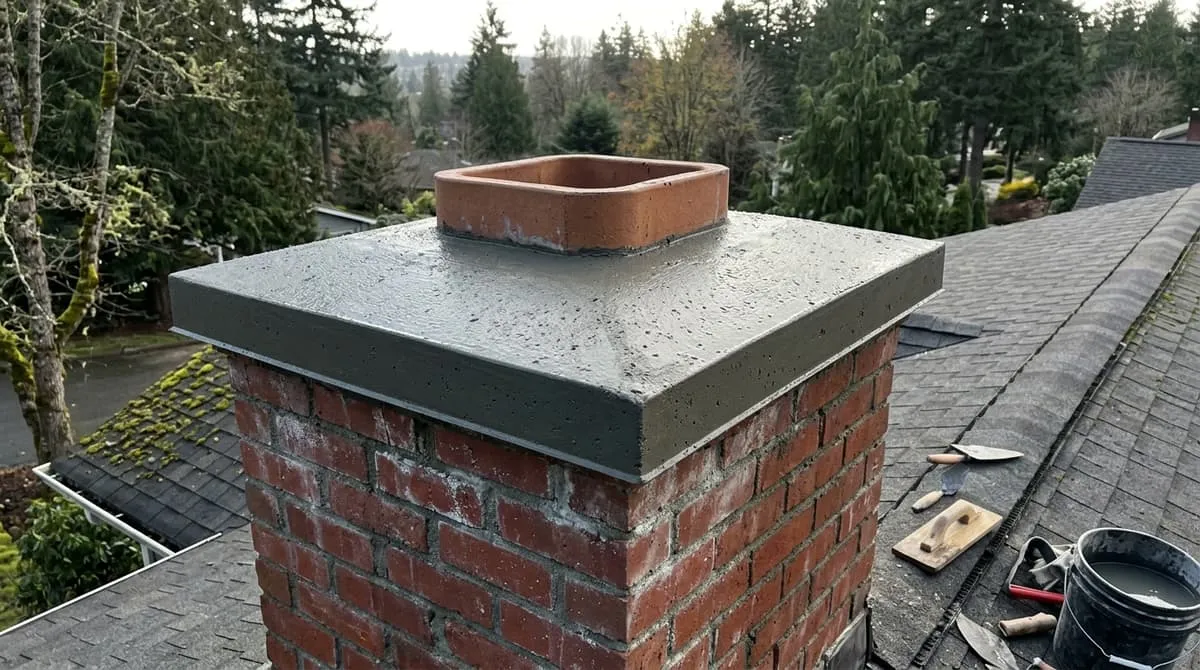
Two chimneys with the same symptom can need very different amounts of work. Here are the factors that actually determine how big a repair job is: access, how far damage has spread, material matching, and timing relative to the season.
Two homeowners can call about what sounds like the exact same problem, a cracked chimney crown, and end up with two very different repair scopes. That reflects real differences in what is actually happening behind the visible symptom, not inconsistency on our part. Once you know what those differences are, a repair estimate stops feeling arbitrary. What follows is not a price list; it is a look at the specific factors that determine how big a repair job turns out to be, on any chimney, anywhere.
How far the damage has already spread
A crack caught early, while it is still confined to the crown itself, is a fundamentally smaller job than the same crack left through two or three more wet seasons. Water travels once it finds a way in: from the crown into the mortar joints, and in the more advanced cases, from the mortar into the flue liner itself. A repair scoped for “reseal the crown” and a repair scoped for “reseal the crown, repoint a course of mortar, and inspect the liner for water damage” are different jobs entirely. The difference is almost always how long the underlying crack sat unaddressed before anyone called. This is the single biggest factor in how a repair scope grows. It is also the one most within a homeowner’s control, since an annual inspection catches most of this at the smaller stage.
Access to the roof, and around the chimney
Not every chimney sits in the same place on a roof. Access affects labor time directly, regardless of how much actual masonry work is involved. A chimney on a single-story roof with a straightforward, safe ladder approach is a different logistical job from one on a steep multi-story roofline, or one crowded by mature trees that limit how equipment and materials can reach it. Properties with heavy tree cover, common across Mercer Island, Shoreline and parts of north Seattle, sometimes need extra time simply for safe access and material staging, independent of the repair itself.
When the mortar and brick have to match
On a visible, street-facing chimney, particularly on an older Craftsman-era home where the brick and mortar color are part of the house’s original character, matching the replacement mortar’s color and composition to the original is part of doing the job properly. That matching takes more care and sometimes more sourcing time than repointing with whatever mortar mix happens to be on the truck. A chimney on the back of the house where visual matching matters less, or one that has already been repaired unevenly in the past, does not carry that same requirement. A visibly mismatched repair on a prominent chimney is a real aesthetic problem worth avoiding, which is why we treat this as a genuine scope difference and not an upcharge.
Structural versus cosmetic
The clearest scope divider is whether an inspection finds cosmetic weather damage or something structural. A hairline crown crack, some eroded mortar, a corroded cap: these are cosmetic and functional repairs, addressing wear without any question about the chimney’s structural soundness. A visible lean, separation from the house at the roofline, or damage following an earthquake calls for a different response, potentially a structural engineer’s input before any repair work is even scoped. We say plainly which category a given chimney falls into. Treating a structural issue as a cosmetic patch underserves a real safety problem; treating a cosmetic one as structural overcharges for a simple job.
What kind of chimney it is in the first place
Masonry and factory-built chimneys are not the same repair category. A masonry crown repair involves concrete work, mortar matching and, in a full rebuild, brick replacement. A factory-built system’s equivalent problem, a failed chase pan or corroded flashing at a metal chase, calls for a different set of materials and techniques, usually manufacturer-specific parts rather than site-mixed masonry materials. The chimney type simply determines which set of skills and materials the job needs.
Timing relative to the season
A repair diagnosed and scoped in the dry stretch of late summer has more flexibility than the same repair discovered mid-winter during an active leak. Masonry work, particularly crown pours and repointing, needs reasonable weather to cure properly. Rushing concrete work in the middle of a heavy wet spell is not good practice, no matter how urgent the leak feels. When a repair turns up during an active leak in poor weather, the first step is often temporary weatherproofing: wrapping and tenting the affected area to stop further water intrusion while waiting for a proper window to do the permanent repair correctly. That two-stage approach is the responsible way to handle a genuine emergency without doing rushed, lower-quality permanent work.
Given how many factors go into a repair’s real scope, a verbal estimate given from the ground, without a proper inspection, can just as easily overstate a simple job as understate a more involved one. Every repair we take on gets a written scope after an actual diagnosis: what was found, what fixing it will take, and why. That written scope protects a homeowner from a job growing without explanation partway through, and it protects an honest quote from being second-guessed for reasons that had nothing to do with the actual work.
Read next
More from the blog
Ready to book?
Describe what you have noticed, and we will tell you plainly what it needs.