
Where a Seattle chimney leak actually starts
Seattle gets roughly 150 wet days a year. Here is where that rain gets into a chimney first, in what order, and what stops it before it reaches the flue.
Published
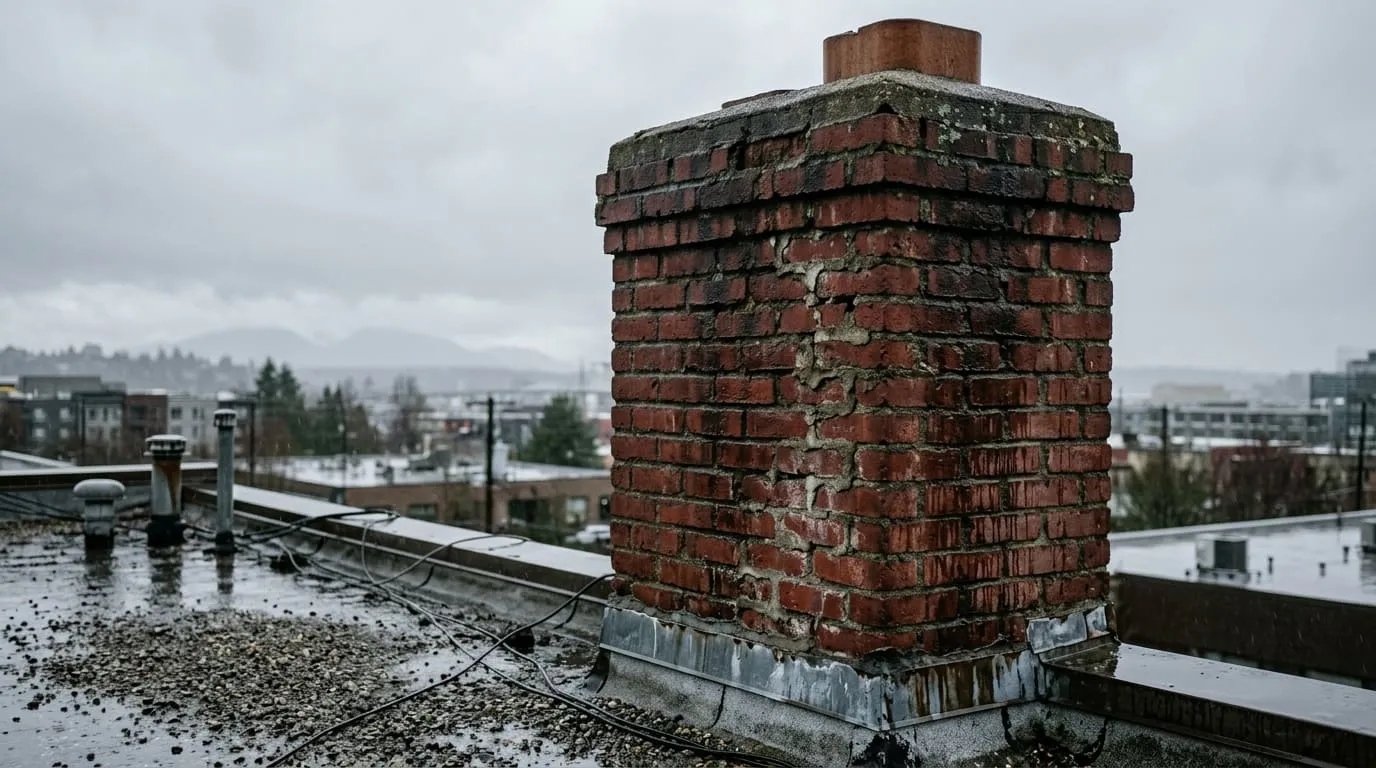
Seattle’s chimney leaks follow a predictable path: the crown cracks first, then the mortar, then the flashing, and only then does water show up as a stain on the ceiling. Here is the order it actually happens in, and where to look first.
By the time a Seattle homeowner notices a water stain spreading across the ceiling near the fireplace, the chimney has usually been leaking for a while. Water does not appear at the point it becomes visible. It enters the system somewhere else, travels through masonry that was never meant to carry it, and only shows up as a stain once it has soaked far enough to reach a surface someone actually looks at. Knowing the order failure happens in is the difference between a small repair and a much bigger one.
It starts at the crown, almost every time
The crown is the slab that caps the stack, concrete or mortar, poured with a fall on it, and its whole job is to throw rain clear of the flue and the brickwork underneath. It is also the single most exposed part of the entire structure, sitting directly under Seattle’s weather with nothing above it. A crown that was poured flat instead of sloped, or one that has simply aged past its original seal, develops hairline cracks. Those cracks look cosmetic. They are not. Once a crack opens in the crown, every rain event after that sends water directly into the masonry core instead of off the roof. Seattle’s climate does not give that crack much of a break: the region averages somewhere around 150 days a year with measurable precipitation, so a cracked crown rarely gets more than a few dry days in a row to offset the damage before the next storm arrives.
From the crown, it moves into the mortar
Water that gets past a failed crown does not pool and stop. It works down through the body of the chimney along the path of least resistance, almost always the mortar joints between bricks. Mortar is more porous than the brick itself and is the sacrificial material in masonry construction by design; it is meant to wear before the brick does, and it is meant to be replaced periodically. In a chimney that has gone years without attention, water traveling down from a cracked crown accelerates that wear dramatically. Each freeze during a cold snap expands whatever moisture is sitting in the joint, widening the crack a little further, and each thaw lets more water in. Over a few winters, mortar that would have lasted decades under dry conditions washes out from the inside, leaving joints that are structurally compromised even when they still look intact from the ground.
The flashing gets blamed first, and is sometimes innocent
Flashing is the metal seal where the chimney meets the roofline, and it is genuinely one of the most common places a leak originates, which is exactly why it gets blamed by default whenever a homeowner sees a ceiling stain near the chimney. Sometimes that is the right diagnosis: step flashing that has corroded, pulled away, or was sealed with caulk instead of properly lapped metal in the first place is a real and common failure on its own. But flashing failure and crown failure produce very similar symptoms from inside the house, and treating only the flashing on a chimney whose real problem is a cracked crown means the leak comes back the next wet season just as bad as before. A proper diagnosis checks both, in the order water would actually travel: crown first, then flashing, then the mortar joints along the way.
The flue liner is usually the last thing affected
It might seem like water reaching the flue liner, the passage smoke travels up and out through, would be an early sign of a leak. In practice it is usually the last stage, because the liner sits inside the masonry core, protected by the brick and mortar around it. By the time water damage has reached the liner, enough has already happened upstream that the repair scope has grown considerably. A small crack ignored for two or three wet seasons in Seattle can turn into a repair involving crown, repointing and liner work all at once, when catching it at the crown stage alone would have been a much smaller job.
Chimneys under mature tree cover, common across much of King County and especially pronounced on Mercer Island and in Shoreline’s older neighborhoods, pick up an additional factor worth naming here: moss and needle litter accumulating directly on the crown. A crown covered in moss stays wet longer after every rain than a clear one does, because the moss holds moisture against the surface instead of letting it run off, and that extended wet time accelerates the freeze-thaw cycle that widens cracks in the first place. Regular debris clearing measurably slows how fast a crown deteriorates on a heavily shaded property; it is not cosmetic maintenance.
Catching it before the ceiling shows anything
A ceiling stain is a late-stage symptom, not an early one. A visible crack across the crown, discoloration on the exterior brick face below the crown line, or mortar that looks chalky or is visibly missing in spots are all earlier warning signs worth acting on before anything shows up indoors. An annual inspection, the kind bundled into a standard sweep visit, catches most of these at the crown or early-mortar stage, while the fix is still small. Waiting for an indoor stain to appear gives the water time to do the more expensive kind of damage.
Read next
More from the blog
Ready to book?
Describe what you have noticed, and we will tell you plainly what it needs.