
Unreinforced masonry chimneys and Seattle’s seismic risk
Why an old brick chimney is a structural question in Seattle, not just a masonry one — what the Seattle Fault and Cascadia zone mean for an unreinforced stack.
Published
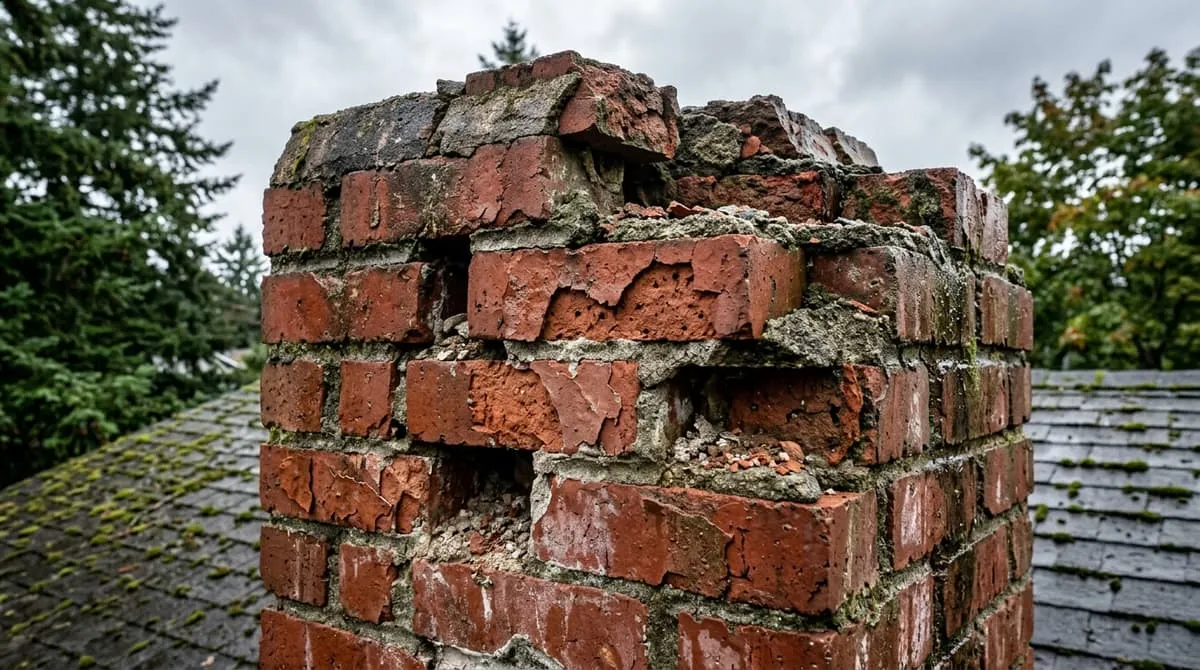
More than 1,500 Seattle-area chimneys were damaged in the 2001 Nisqually earthquake, concentrated almost exactly along the Seattle Fault. Here is what that means for an unreinforced brick chimney today, and when a post-event inspection actually matters.
Ask a structural engineer which part of an older Seattle house is most likely to fail first in an earthquake, and a surprising number will say the same thing: the chimney. Not the foundation, not the roof framing, but the tall, freestanding, largely unreinforced brick stack rising above the roofline, disconnected from the rest of the structure at exactly the point where shaking loads concentrate hardest. This is not a hypothetical. It is documented, measured, and specific to this region.
What actually happened in 2001
On February 28, 2001, the magnitude 6.8 Nisqually earthquake shook the greater Seattle area for about 45 seconds. In the aftermath, the U.S. Geological Survey conducted a block-by-block survey of chimney damage across roughly 50 square kilometers, examining approximately 60,000 chimneys and documenting 1,556 that were damaged or destroyed. That damage did not spread evenly across the city. It clustered strongly along a corridor running from Bremerton through West Seattle, South Park and Beacon Hill, and that corridor lines up almost exactly with the surface trace of the Seattle Fault. Chimneys, more than any other single residential building component, turned out to be the most reliable indicator of where the shaking hit hardest.
Two different faults, two different kinds of shaking
Seattle sits in a genuinely unusual position for seismic risk, because it faces two distinct sources of earthquake shaking with two different characters.
The Seattle Fault runs east-west directly beneath the city, from roughly Bremerton through West Seattle and south Seattle. A rupture on this fault would be shallow, less than 25 kilometers deep, which tends to produce more intense shaking at the surface directly above it, in a relatively concentrated area.
The Cascadia Subduction Zone is an entirely different kind of hazard: an offshore megathrust fault running roughly 1,000 kilometers from northern California to Vancouver Island, where the Juan de Fuca plate slides beneath the North American plate. Cascadia last ruptured in January 1700, producing an estimated magnitude 8.7 to 9.2 earthquake, among the largest in recorded history anywhere. A Cascadia event generates deep, longer-duration shaking felt across a much wider area than a Seattle Fault rupture. The recurrence interval for a Cascadia rupture is estimated at roughly 300 to 500 years, which puts the region inside a window where the next one is not a remote possibility.
Both faults matter for the same reason where a chimney is concerned. Sustained or intense ground shaking is what breaks unreinforced masonry, and Seattle has two separate, well-documented sources capable of producing it.
Why a chimney specifically is so vulnerable
An unreinforced brick chimney is, structurally, close to the worst possible shape for seismic resistance: tall, narrow, heavy, made of a material with almost no tensile strength, and typically connected to the house only at the roofline rather than tied into the framing along its full height. Older construction, the Craftsman-era chimneys common across Wallingford, Ballard, Ravenna and much of Seattle’s older housing stock, predates modern seismic bracing requirements entirely. There is no steel reinforcement running through the masonry and no positive connection tying the stack to the roof structure to keep it from swaying independently during shaking. When the ground moves, the chimney is, in effect, a tall stack of individually mortared bricks trying to move together with nothing holding them to that plan.
Where the city’s URM program does and does not reach
Seattle maintains a database of more than 1,100 unreinforced masonry buildings, generally larger structures built mostly before 1945 with load-bearing brick or masonry walls, that the city has identified as seismically vulnerable, and a voluntary retrofit standard for those buildings was adopted in late 2024. That program targets building-scale masonry: apartment buildings, commercial structures, buildings with masonry parapets and walls. A single-family home’s brick chimney is not generally what that formal URM database tracks. But the underlying physics is identical. An unreinforced brick chimney rising above a house’s roofline is, in miniature, exactly the kind of unbraced masonry appendage the city’s own building code treats as a hazard on larger structures: tall, disconnected, and prone to toppling or cracking under lateral shaking, whether or not the building it sits on happens to be tracked in a formal registry.
What this means for an inspection, practically
NFPA 211, the national standard chimney professionals are measured against, calls for a Level 3 inspection whenever an event like an earthquake may have compromised a chimney. Seismic damage to masonry is not always visible from the ground or even from a casual look at the roofline. A chimney can develop internal cracking, loosened mortar joints, or a partial separation from the house at the roof connection without any of that being obvious to someone standing in the yard. Given that a shallow Seattle Fault event or shaking from a Cascadia rupture are both real possibilities here, and given how consistently chimneys were the first thing to show damage in 2001, a Level 3 inspection after any earthquake felt in the area is a reasonable, inexpensive precaution.
What can actually be done about an older brick chimney
The options for an unreinforced masonry chimney generally fall into a few categories, and which one makes sense depends on the structure and how it is used. Bracing the chimney, adding steel connections between the stack and the roof framing, is one path, most relevant where the fireplace is still in active use. For a chimney that serves a fireplace no longer in service, removal down to roofline is often simpler and less expensive than a full seismic retrofit, and it eliminates the hazard rather than managing it. For a chimney with no visible distress and continued light use, a Level 1 or Level 2 inspection on a normal annual schedule, combined with a Level 3 check after any felt earthquake, covers the ground without jumping straight to major structural work.
Plenty of unreinforced brick chimneys have stood for a century without incident, so none of this makes an old chimney automatically a problem. It is a genuine, well-documented category of seismic risk specific to this region, backed by a real dataset from a real earthquake rather than general caution. If the chimney predates modern construction, has never been evaluated for seismic bracing, or the region has felt any earthquake since the last inspection, a proper structural look is worth the relatively small cost of finding out rather than assuming.
Read next
More from the blog
Ready to book?
Describe what you have noticed, and we will tell you plainly what it needs.